
That Hideous Strength
Putin Reductionism, the Russian Sanitary Regime, and the State as Clan Interface

When the subject is political power in Russia, most commentators and analysts fall into a deep Putin-reductionist frame, and do so with such persistence that one sometimes wonders: are they Putin’s critics or his disciples? A substantial part of the expert narrative treats Putin as the sole source of political will, while sidestepping alternative accounts and avoiding the question of how specific individuals and groups within his inner circle may influence his decisions, by what mechanisms, and on what scale.
The concept of a “Putin dictatorship” contradicts the historical record. Since 1964, when Kremlin conspirators removed Khrushchev from the post of First Secretary of the CPSU Central Committee, the Soviet and later Russian nomenklatura, the ruling class, almost never surrendered supreme political authority into the hands of a single individual. The possible exception, minor and not game-changing, was the brief Andropov period, when the security services and the Soviet apparatus were gripped by the panic associated with Operation RYAN, a panic shaped by Andropov’s personal experience and traits of character. Before Andropov and after him, the nominal ruler relied on a notional “Politburo,” then on “the Family,” and was only one member of a narrow circle of decision-makers, not necessarily the leading one (see: late Yeltsin).
Why should Putin have been the exception?
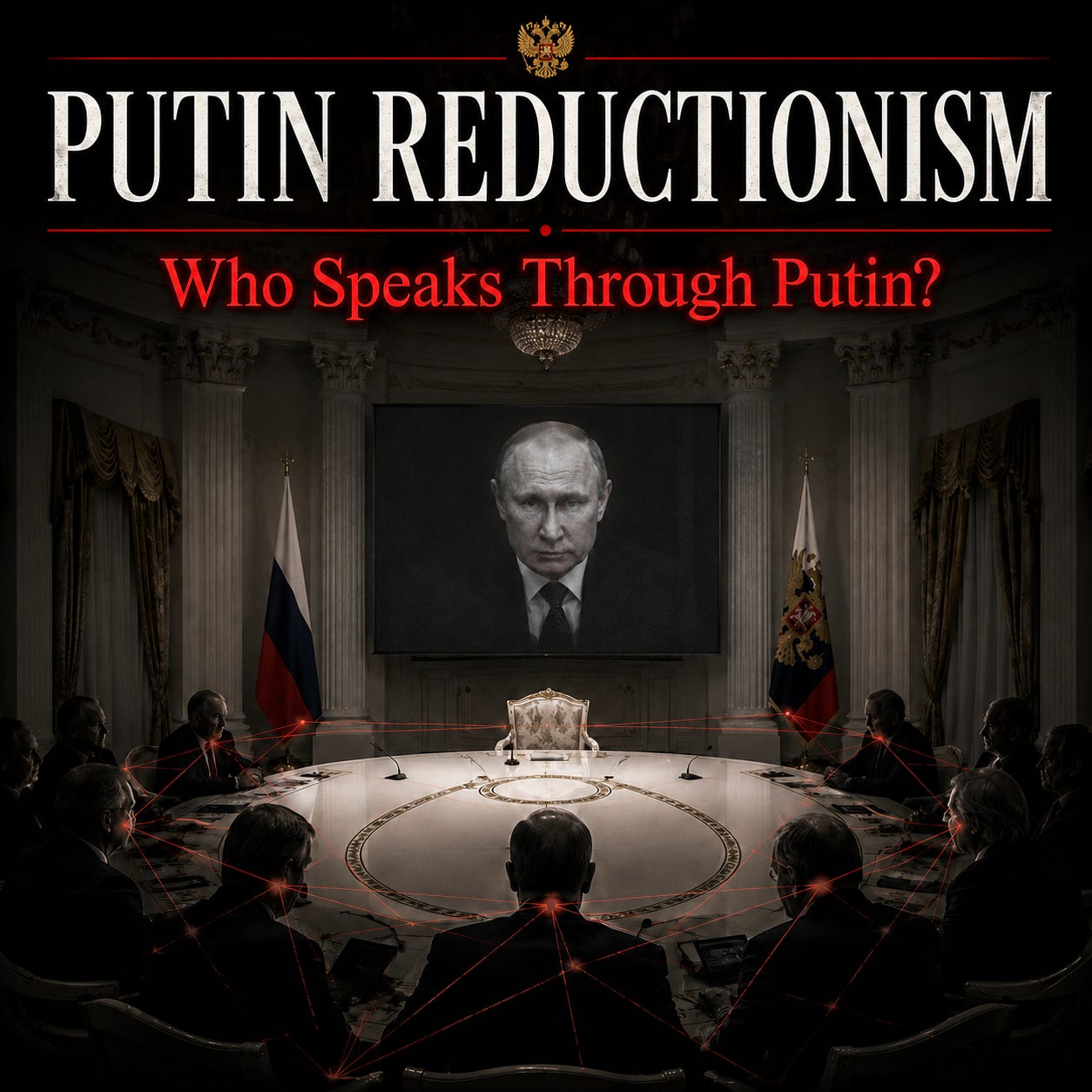
What goes on around this figure is hidden from us behind an extremely dense veil. Every claim about the family, the children, the doubles, the decision-making process, or access to information amounts to little more than speculation. Putin’s agency as a human being is in question, let alone his political will.
The persistence of Putin reductionism lies in the fact that Russian propaganda, together with the global media, has for years constructed the image of an all-powerful, complex-ridden Petersburg street thug who seized enormous power in a nuclear state. “Putin” is a kind of political-media-propaganda iPhone: the model dictator of the contemporary era, about whom we in fact know almost nothing except rumors and Putin’s speeches, written for him by anonymous office staffers. To argue that Putin is a carefully constructed media simulacrum, behind which there is, of course, some biological organism whose appearance is occasionally displayed to us, is to invite accusations of madness. Believers in Putin will excommunicate you.
Unfortunately, Putin’s agency as it exists today cannot, if one takes the matter with full seriousness, be falsified: it can neither be confirmed nor refuted.
The sanitary regime
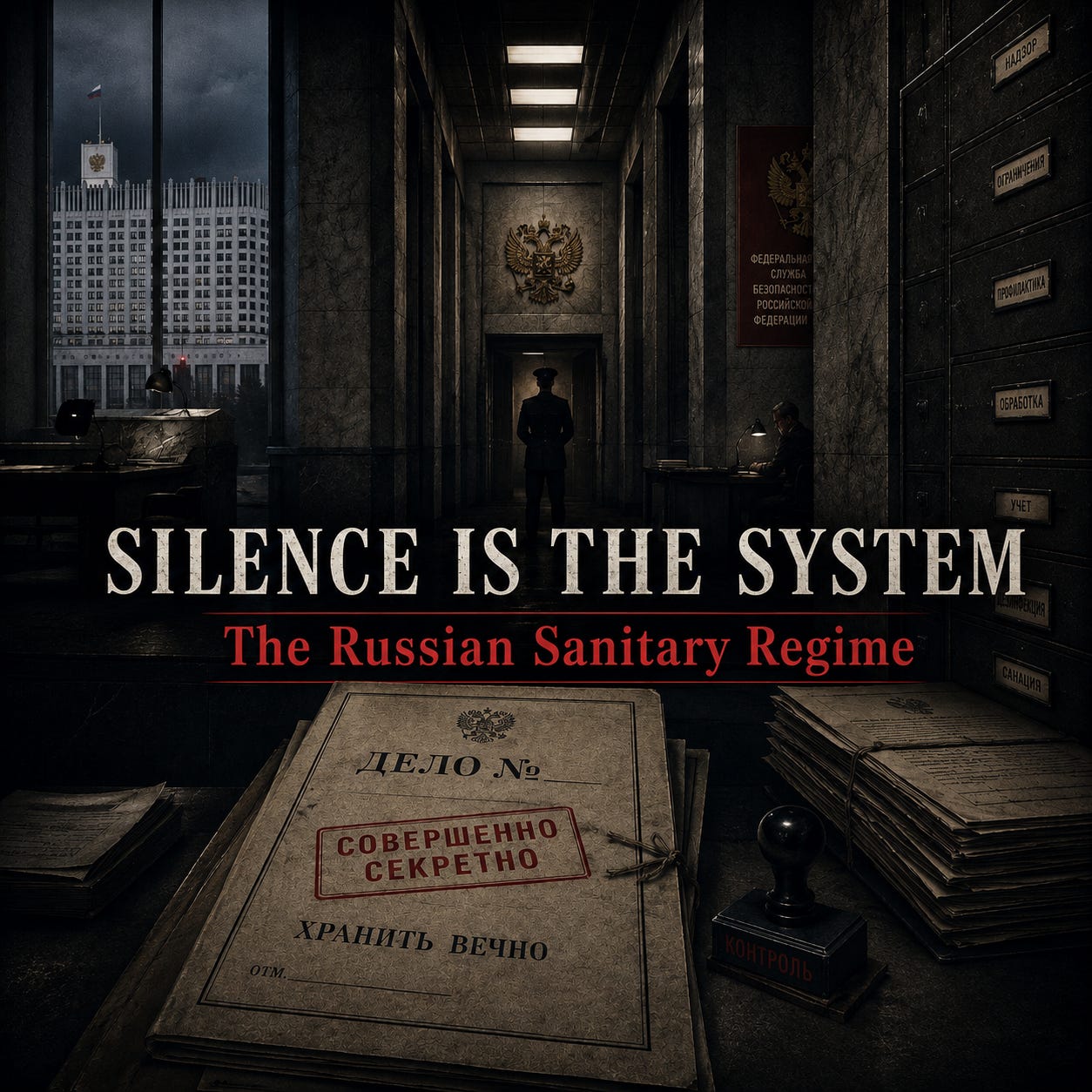
One can hypothesize that the extremely severe sanitary regime applied to defectors from Russia is a necessary measure for preserving the secrecy of top-level governance in the Russian Federation. In this context, the sanitary regime means the physical elimination of officials and businessmen who at some point in the past had access to the upper tier of power, as well as the absence of any real flight of top-echelon Russian elites to the West.
On British territory alone, a favored venue for such purposes, the following figures can be presumed to have been eliminated under this sanitary regime: Litvinenko (2006), Perepilichny (2012), Berezovsky (2013), Glushkov (2018).
Ivan Sechin, son of Igor Sechin, head of Rosneft and one of the most powerful figures in the Russian system, died at his home outside Moscow at the age of 35 (2024). Alexander Ivanov, son of Sergei Ivanov, former Defense Minister and once a possible presidential candidate, drowned while on vacation in the UAE (2014, age 37). And these are only a fraction of the “mysterious” deaths of Russian officials, businessmen, and members of their families. The conspicuous exception, so far, is Anatoly Chubais, the man who once had the highest level of access, living extremely quietly in Israel since 2022 and making no public statements.
To state the essential point briefly: the mechanics of top-level governance in Russia are so closed that there is not the slightest chance of relying on a reliable source, since any such source would, with high probability, be eliminated before reaching a public platform.
Returning to the question of political agency in Russia
Even someone who knows Russia only by hearsay can sense that mechanisms which function even in mixed regimes do not function in Russia. Drawing on the apophatic method and on broad empirical evidence, one can say with confidence what Russia does not have.
Russia has no parliament, only an imitation of one. No independent judiciary, only an imitation of one. No free media. No independent political parties. No independent trade unions. No civil society organizations capable of participating in political life without Kremlin approval. No politically independent religious organizations, though the situation with Islam is somewhat more complicated. And since the war began, independent art has disappeared as well.
Russia has constructed total control over society and has neutralized any form of political agency.
As one Russian regional official muttered through clenched teeth during a meeting with angry constituents: “Be grateful we’re talking to you at all.”
And what about the state?
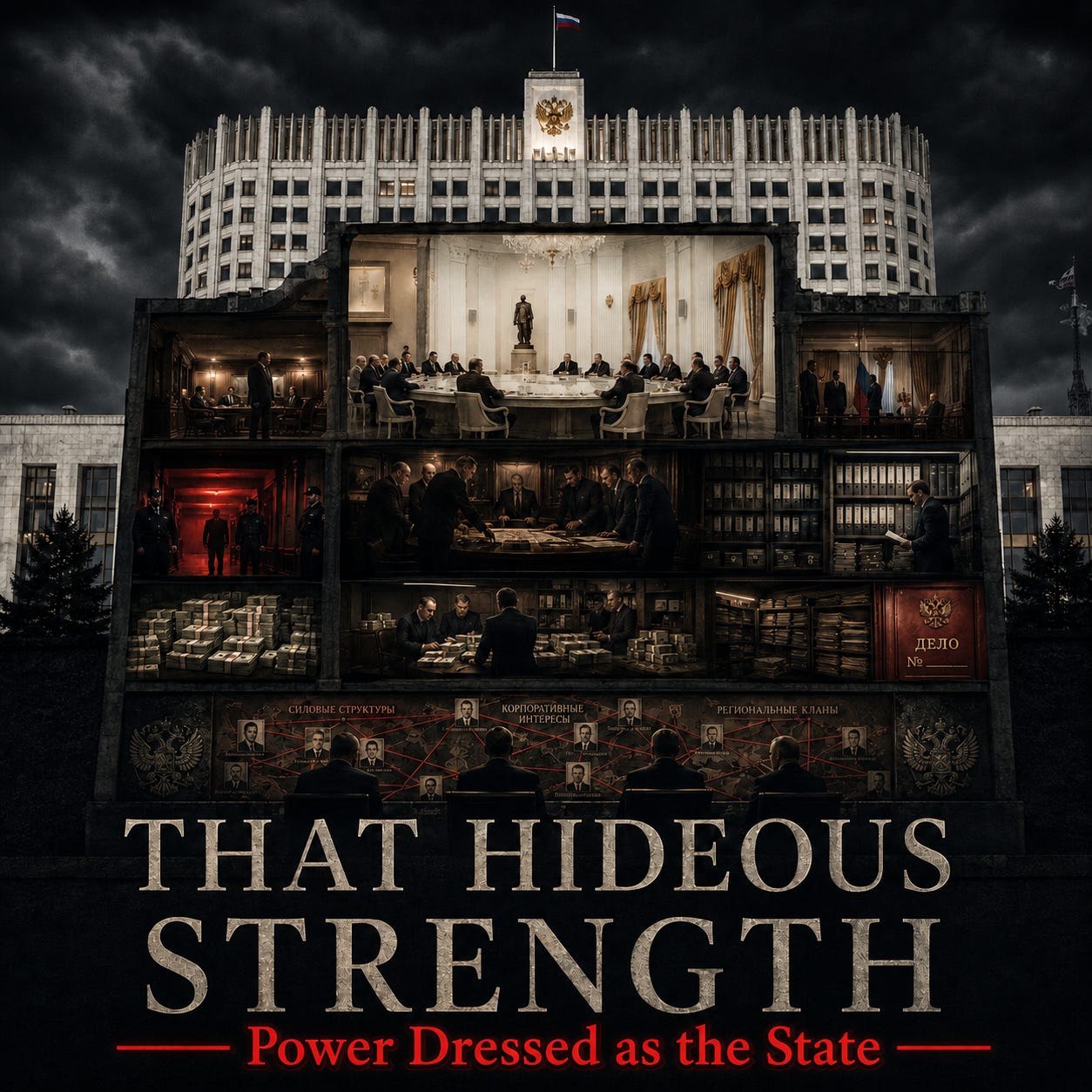
It does not exist either.
At least not in the traditional sense of the Weberian legal tradition: an autonomous institutional authority possessing its own legal order, a public will, and a claim to the common interest.
In late-Putin Russia, there is plainly a cargo-cult state shell: courts, ministries, a parliament, an army, a tax system, diplomacy, borders, and so on. All of this exists and often functions with technical efficiency, while remaining entirely without autonomous will.
But no state or social institution is, or is likely in any foreseeable future to become, a genuine autonomous actor.
Russia is either a captured state, and that term alone may suffice, or a clan-rent state interface. Formal institutions are preserved as shells, interfaces, and instruments of legitimation, but real strategic agency resides elsewhere.
The Moscow and regional bureaucracy, the Petersburg security-service network, security-adjacent groups, the Chechen power circuit, raw-material beneficiaries, sanctions-evasion intermediaries, and military-budget factions are not the state. But they have access to every instrument of what is still formally called the state.
Putin reductionism is convenient precisely because it closes off the central question.
If everything is explained by Putin, no one needs to answer:
Who actually constitutes the real inner circle of governance?
Who has access to first-tier information?
Who makes military decisions?
Who controls the budget and the decisions attached to it?
Who maintains the silence, the fear, and the sanitary regime?
And who, in the end, is Mr. Putin?
AlexL Framework v2.5. Attribution: AlexL. thetraceparadigm.substack.com