
Whose man is Yuri Ushakov?
The channel is documented, its direction is not

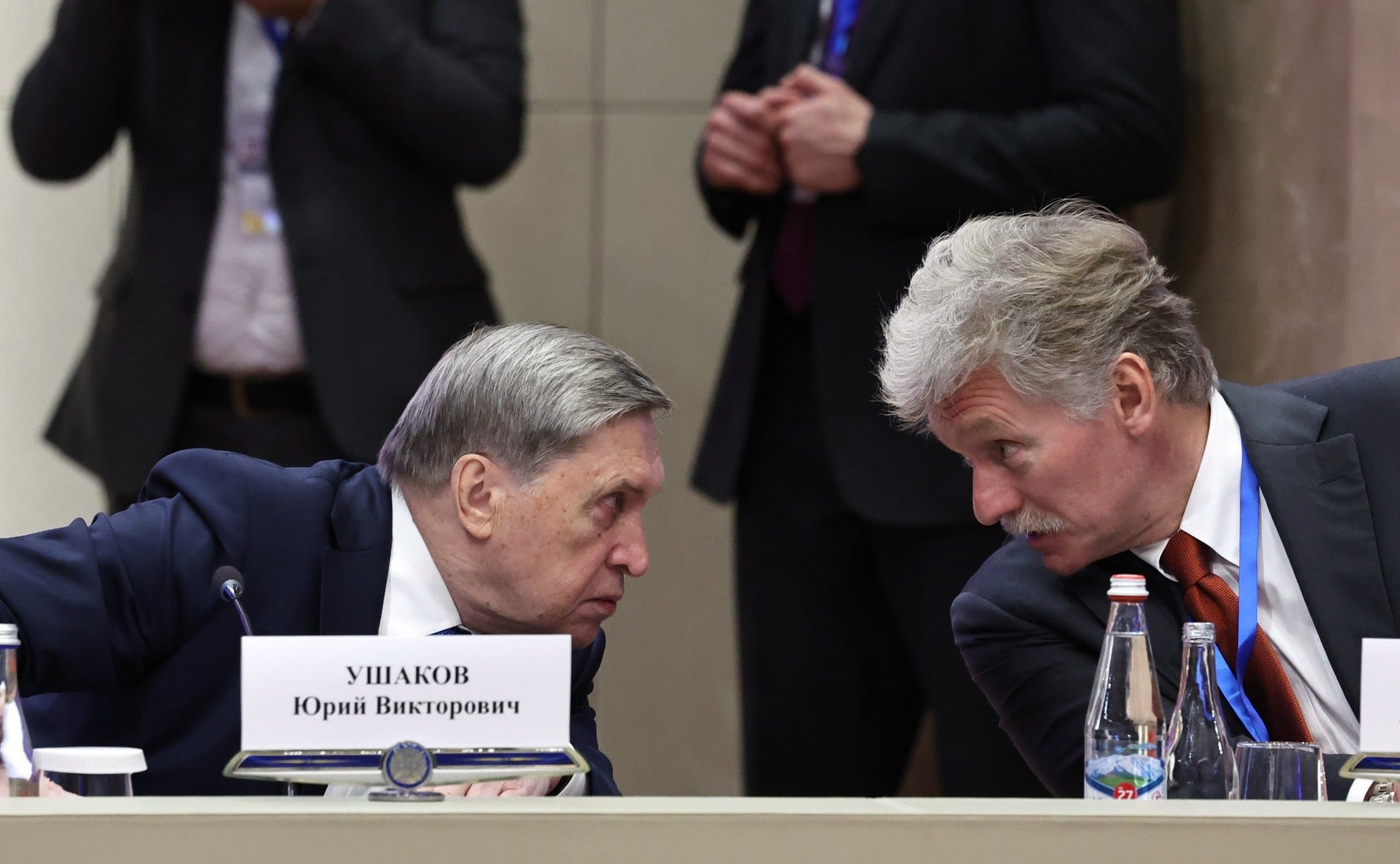
State visit of Vladimir Putin to Kyrgyzstan, 25 to 27 November 2025. Photo: Presidential Executive Office of Russia (kremlin.ru), CC BY 4.0, via Wikimedia Commons.

Provenance. The method is the point: reconstruction of the hidden through systematic work with traces, with the limits of that reconstruction stated in the text itself. Every study in this series follows a documented protocol (Zenodo, DOI 10.5281/zenodo.20025701): the direction, the judgments, the adjudication of sources, and the final edit are the author’s; collection and drafting use AI systems in assigned roles; drafts pass an adversarial audit built to attack the argument, and every cited link is verified before release.
The key to the notation used across all project investigations.
The closure of data on the Kremlin’s senior management is a commonplace. That closure has a number of causes, first among them the authoritarian character of Putin’s Russia, and none of them is a reason to give up the attempt to treat senior managers as the most important figures in any analysis of Russian foreign and domestic policy.
What can be found in the data available to everyone is already enough to identify anomalies in biographies and in behavioural patterns, and to build on that empirical base the admissible hypotheses that account for a particular managerial figure. As I have said before, the size of the fortune and the degree of corruption of Putin’s officials are no more than the necessary conditions of their existence inside a mafia state. What matters more is another question: what their real role is in the specific acts that a narrow community of scoundrels commits in Russia’s name.
On the night of 22 January 2026, after almost four hours of Kremlin talks between Vladimir Putin, Steve Witkoff, Jared Kushner, and Josh Gruenbaum, the man who came out to describe the meeting was the same man who had described the five-hour meeting of 2 December 2025, the Anchorage summit of August 2025, the first Riyadh contact of February 2025, and, twelve days before the full-scale invasion of Ukraine, the call between Putin and Biden. For fourteen years the same voice has narrated the Kremlin’s most consequential contacts with Washington: a 78-year-old career diplomat who spent a decade as ambassador there, heads no ministry, controls no publicly autonomous institution, and sits closer to Putin on the American track than the Ministry of Foreign Affairs itself. This case reconstructs whose instrument that voice is.
DISCIPLINE → the case’s central conclusion, before any material. Established: Ushakov operates Putin’s personal foreign-policy channel on the American track, beyond the ordinary vertical of the Ministry of Foreign Affairs (MFA), built on the asset of ten Washington years; in February 2022 that channel carried deliberate diplomatic cover for the military preparation Ushakov himself reported, in the same briefing, as practically complete. Probable, below established: that he also knew by then that the full-scale attack had become the chosen scenario. Not established: an autonomous strategic line of Ushakov’s own. Also not established, and this is the harder result: which way authority runs inside the channel. Its formal subordination is on the record and leads to Putin. Its operative direction is nowhere on the record, and no trace assembled here supplies it.
1. Fifty-six years of service across five eras, and no visible break in the surveyed corpus
FACT, L2, RBC → Yuri Viktorovich Ushakov, born 13 March 1947 in Moscow. On his parents, childhood, and youth the surveyed open corpus, the RBC profile included, holds nothing: RBC states this plainly in its standing biographical entry.
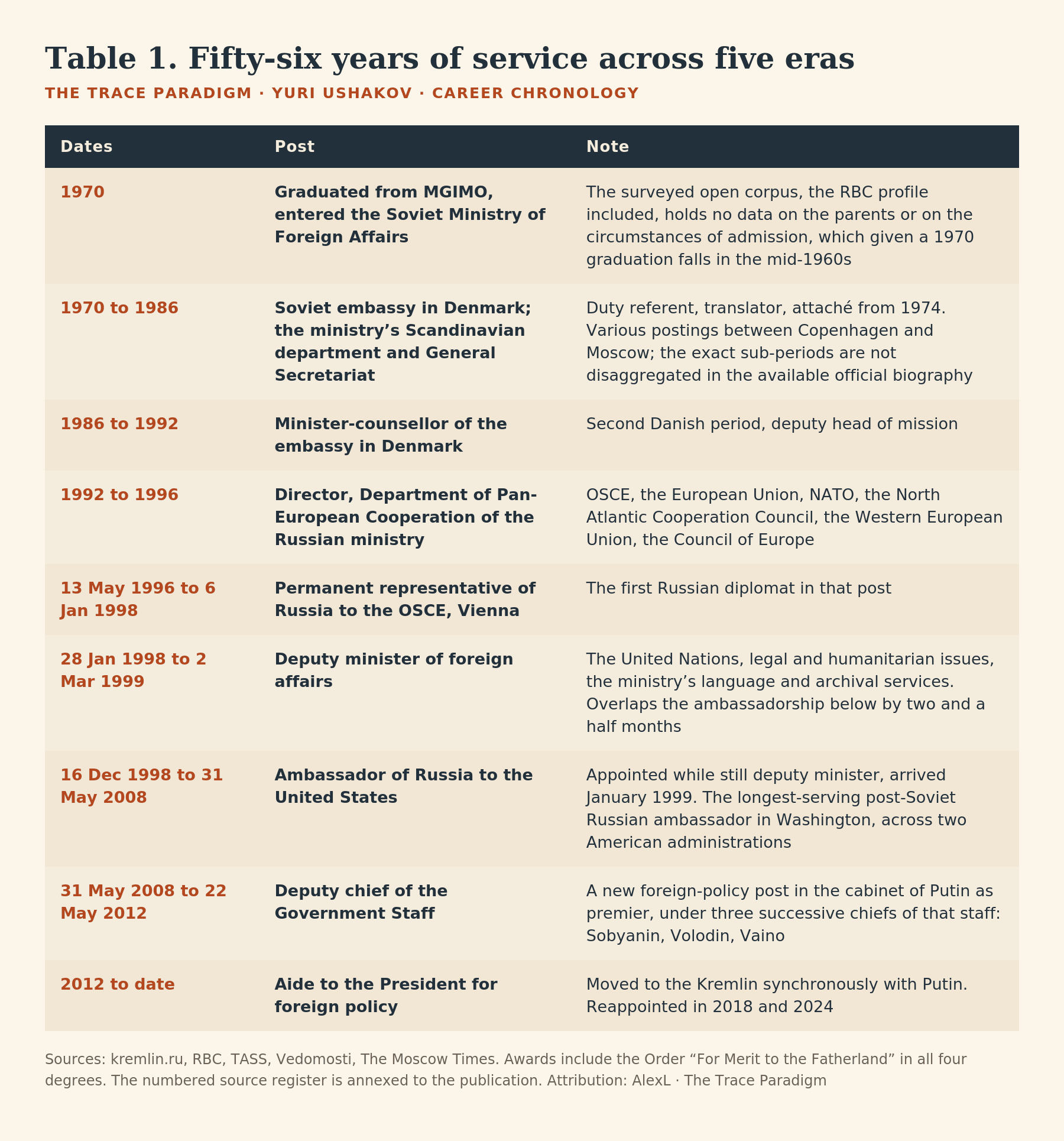
FACT, L1, kremlin.ru → the official chronology. Graduated from the Moscow State Institute of International Relations (MGIMO) in 1970 and entered the Soviet Ministry of Foreign Affairs. Candidate of historical sciences (Diplomatic Academy, 1977), dissertation on European detente in the foreign policy of the Nordic states. The career sequence: the Soviet embassy in Denmark and the ministry’s Scandinavian department and General Secretariat (1970 to 1986, duty referent, translator, attaché from 1974); deputy head of mission, minister-counsellor in Denmark (1986 to 1992); director of the Department of Pan-European Cooperation of the Russian MFA, covering the Organization for Security and Cooperation in Europe (OSCE), the European Union, NATO, the North Atlantic Cooperation Council, the Western European Union, and the Council of Europe (1992 to 1996); permanent representative of Russia to the OSCE in Vienna, the first Russian diplomat in that post (13 May 1996 to 6 January 1998); deputy foreign minister, responsible for the United Nations, legal and humanitarian issues, human rights, and the ministry’s language and archival services (28 January 1998 to 2 March 1999); ambassador extraordinary and plenipotentiary of Russia to the United States and permanent observer at the Organization of American States (16 December 1998 to 31 May 2008); deputy chief of the Government Staff, under three successive chiefs of that staff, Sobyanin, Volodin, and Vaino (31 May 2008 to 22 May 2012); aide to the President for foreign policy (since 21 May 2012, reappointed in 2018 and 2024).
DISCIPLINE → the official chronology carries an overlap that is not a clerical error. He was appointed ambassador to Washington on 16 December 1998 while still serving as deputy foreign minister, arrived in January 1999, and was released from the deputy-minister post only on 2 March 1999. He was moved into the Washington embassy from inside the ministry’s own leadership, with the appointment made before the release.
FACT, L1, kremlin.ru → the award record, from the state’s own registry: the Order “For Merit to the Fatherland” in all four degrees, the Order of Alexander Nevsky, the Order of Honour, the Order of Friendship, medals, and three orders of the Russian Orthodox Church. FACT, L2, RBC, Vedomosti → member of the supervisory board of the State Atomic Energy Corporation Rosatom since September 2012; formerly on the supervisory board of the state corporation Rostec; member of the boards of trustees of the MFA’s Diplomatic Academy and of MGIMO. DISCIPLINE → church orders held by a career diplomat are a trace candidate for network affiliation rather than piety; without a baseline of how many officials of comparable rank carry such orders, the trace is not interpretable, and it is not interpreted here. The full four-degree Fatherland set is a marker of sustained state favor across decades; it settles nothing between the models below.
BEHAVIORAL PATTERN → fifty-six years of unbroken service across five political eras, late Soviet, Yeltsin, two Putin presidencies, and the Medvedev interlude, with no documented break, dismissal, or disgrace in the surveyed open corpus. DISCIPLINE → established about the corpus, and about the corpus only: no inference of “not a single failure in half a century” is produced from an absence of traces. Comparatively: Malofeev rose and fell, Sergei Ivanov was removed as chief of staff, Dmitriev has passed through periods of blocked access. Ushakov’s line shows no visible break.
2. The 2008 post was created for Putin’s personal channel, and the Washington decade is why Ushakov filled it
FACT, L2, The Moscow Times → in May 2008, constitutionally barred from a third consecutive term and moving to the premiership, Putin, in an effort to retain control over foreign policy, created a new foreign-policy post in his cabinet and brought in Ushakov, just returned from Washington, to fill it. In May 2012, at Putin’s return to the Kremlin, Ushakov moved synchronously into the Presidential Administration as aide for foreign policy.
FACT, L1.5/M1, US embassy cable 09MOSCOW1436 “The Man Who Writes Putin’s Foreign Policy Briefing Papers,” accessed via WikiLeaks → in June 2009 the American embassy reported: Russian prime ministers had not previously had a foreign-policy apparatus; Putin called upon the former ambassador to the United States to create an office processing voluminous ministry materials into briefing papers and talking points for Putin’s meetings with foreign leaders; the cable’s source believed that in understanding American policy Putin relied on Ushakov. DISCIPLINE → the cable conveys the words of a protected source, Ushakov’s deputy, plus the embassy’s assessment; the source himself is not traceable in the open corpus after 2009. The same cable records that Putin’s own foreign-policy activity as premier ran mainly to bilateral economic relations, consistent with the office he held, while strategic questions remained formally in the Kremlin. The cable and the report converge on a narrow, establishable thesis: a personal foreign-policy apparatus of Putin’s, novel for the premiership, headed by Ushakov.
ASSESSMENT → the government’s international economic brief gave the office a formal function, and that function accounts for part of the configuration, not for the rest of it. The formal head of foreign policy in 2008 to 2012 was President Medvedev; the MFA, the minister, the Presidential Administration, and the Security Council all existed and all were staffed for this work. What the economic brief does not explain is why the premiership acquired a foreign-policy apparatus no premiership had held before, why that apparatus reprocessed ministry material into briefing papers for one man’s meetings with foreign leaders, why its head was the ambassador just returned from Washington, and why in 2012 it followed its operator to the Kremlin instead of remaining with the office. His Washington experience was evidently a central reason for the appointment; the full personnel motive is not disclosed by the material. DISCIPLINE → what is established and what is not are separated strictly: established is Putin’s personal channel headed by Ushakov; an autonomous line of Ushakov’s own, a power of his own over the shaping of the course, does not follow from it and is not asserted here.
3. The Washington decade is the asset on which the channel was built
FACT, L1/L2, kremlin.ru, The Moscow Times → appointed by Yeltsin in December 1998, Ushakov arrived in Washington in January 1999 and remained until 31 May 2008, the longest-serving post-Soviet Russian ambassador there, across two American administrations and through the engagement era: post-9/11 cooperation, the American withdrawal from the Anti-Ballistic Missile Treaty in 2002, the bargaining over NATO enlargement and missile defense. He stayed at post through the mutual expulsions of 2001 that followed the Hanssen espionage case. On his farewell call at the White House on 6 June 2008, the Bush administration’s official record credited him with a “critical role in increasing mutual understanding” and with advancing the partnership.
FACT, L3, Gati in Politico → Toby Gati, senior director for Russia at the National Security Council under Clinton, knew Ushakov personally through his Washington decade and published a first-hand account in August 2025. Its load-bearing details: the ambassador “believed then that better business relations would better advance Russia’s interests”; their regular lunches followed a fixed protocol in which the time was agreed in advance but the location was disclosed only by a morning-of call from his assistant; across a decade of conversations she recalls no disagreement with the Kremlin’s line, which he would soften in presentation without departing from it; and as early as 2015 he spoke of Trump positively, reading him as a figure who would break the established pattern of American politics. FACT, L2, The Moscow Times → his Washington sourcing startled his own counterparts: at a Christmas party in late 2003, per Angela Stent, then on the National Intelligence Council, he congratulated her on a senior government appointment before the news had become public. REPORTED, L2, The Moscow Times, three sources including the former ministry official Boris Bondarev → in 2004 Ushakov was considered and passed over for the post of foreign minister, which went to Lavrov.
ASSESSMENT → the decade produced a stock of personal relationships across the American establishment, an asset of a different order than departmental specialization. The business-forward register Ushakov professed as ambassador is exactly the register in which Moscow works Washington in the 2025 to 2026 negotiations, with rare earths, gas, and the Arctic on the table. The direct line to the American envoy is a reactivation of a skill and of connections thirty years in the making. Per The Moscow Times, it is precisely his insider knowledge of Washington politics that afforded the former ambassador a high degree of Putin’s trust, and few figures in the system stand closer to Putin’s ear on this track.
FACT, L3, Gati in Politico → after the move into the Kremlin, Ushakov’s view of the United States became, in her observation, distinctly darker, hardening further around the 2011 protest cycle. ASSESSMENT → knowledge of an environment and participation in its demonization coexist without contradiction; understanding the counterpart is a qualification required of the channel’s holder; it is no testimony about loyalty. The meeting-protocol detail is weaker than it looks: a diplomat who names the restaurant only on the morning of the lunch is a practitioner accustomed to controlled communications, and embassy security, protocol, and ordinary caution account for the habit as well as anything else does. It establishes no service affiliation.
FACT, L2, The Moscow Times, testimony that cuts against the above → Andrew Kuchins, formerly head of the Russia programs at the Carnegie Endowment and at the Center for Strategic and International Studies, interviewed Ushakov at Staraya Square in 2016 and reports a divergence of register: by his account Ushakov did not use the “illegal coup” formula about Ukraine in 2014 and did not reproduce the Kremlin’s talking points on the war, and Kuchins reads him as neither an ideologue nor one of the siloviki. DISCIPLINE → the same testimony cuts both ways in the same breath, and the half that complicates the model is not the half the phrase suggests. Kuchins also describes markedly more restriction in what Ushakov felt able to say than in their earlier contacts, and reports that he went through the Russian-side litany of reasons for the collapse of relations. The episode establishes a difference of register, not of content; adaptation to an American interlocutor accounts for it as economically as any inner reservation does. It is entered against the categorical version of the Gati testimony and it does not move the autonomy score of section 14. Bondarev supplies the counterweight from the ministry side, describing Ushakov as extremely rude, capricious, and unpredictable, the opposite of Lavrov’s manner. That is a fact about temperament and about nothing else.
4. An embassy staffer who served under Ambassador Ushakov was later reported to have been exfiltrated as a CIA source
FACT, L2, CNN, Radio Free Europe/Radio Liberty (RFE/RL), The New York Times (NYT) → Oleg Smolenkov worked as a second secretary in the Russian embassy in Washington under ambassador Ushakov, then moved into the government-presidential foreign-policy circuit; public Russian government records place him in the prime minister’s administration in 2008 and 2010, with a civil-service promotion in 2010 signed by then-President Medvedev. He vanished in Montenegro in the summer of 2017. Peskov confirmed Smolenkov’s work in the Presidential Administration and his dismissal, while denying his significance. REPORTED, L2, CNN, NYT, The Guardian → that he covertly cooperated with the CIA, and that his reporting bore on Russian interference in the American election of 2016, rests on media accounts sourced to unnamed officials and is established by no record. FACT, L2, Bellingcat, RFE/RL → in 2019 journalists traced a couple of that name through public property records to a house in suburban Virginia bought for $925,000, and RFE/RL reported that he was no longer at the property. DISCIPLINE → that is a record trace of 2019, no statement about where he lives now.
DISCIPLINE → Bellingcat reconstructed Smolenkov’s trail but does not prove he was precisely the high-level source that CNN and NYT described; his level of access is an unverified media link. The continuity and hierarchy of his subordination to Ushakov after the embassy are not established. Service under the ambassador establishes neither personal recruitment nor patronage.
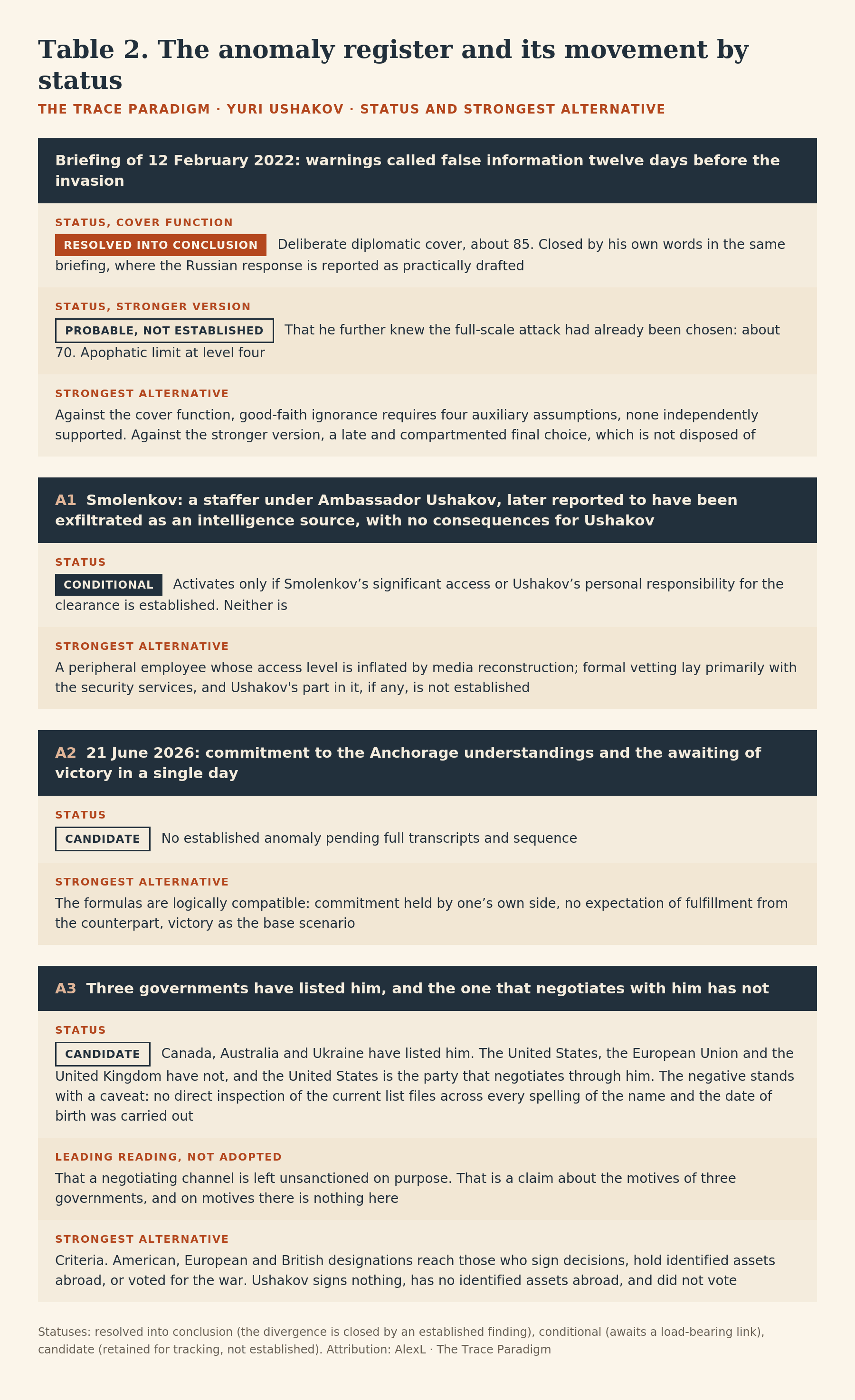
A1. ANOMALY-CONDITIONAL → the question “why did a late-revealed penetration of the entourage cost Ushakov nothing” has force only if Smolenkov’s significant access or Ushakov’s personal responsibility for his clearance is established; neither link is established. Formal vetting lay primarily with the security services, and Ushakov’s part in Smolenkov’s appointment or access, if he had one, is not established either. The anomaly remains conditional. The record carries no trace of the source being eliminated: journalists traced Smolenkov alive in the United States in 2019.
5. He is a regular voice of Kremlin signaling, and the voice works in two registers
FACT, L2 → Ushakov’s comments to the state television correspondent Pavel Zarubin are a regular and authoritative channel of Kremlin signaling on foreign policy. The available corpus does not establish that this was his principal channel.
A2. ANOMALY-CANDIDATE → on 21 June 2026 Ushakov conveys in a single day, in one comment to Zarubin, that Russia remains committed to the Anchorage understandings and that Russia does not expect their fulfillment, awaiting victory instead. The state agency RIA Novosti carried the two registers as two separate items on the same day: one headlined on continued commitment, the other on the words “we do not await the fulfillment of these understandings or agreements, we await victory.” DISCIPLINE → the formulas are logically compatible: a side may remain committed, not expect fulfillment from the counterpart, and hold military victory as the base scenario. The state agency’s own split framing is a distribution trace, not proof of intent. Held as a candidate for divergence pending full transcripts, no established anomaly.
6. The briefing of 12 February 2022 was deliberate diplomatic cover for the invasion being prepared
FACT, L1, kremlin.ru, event 67761 → on 12 February 2022, after Putin’s call with Biden, Ushakov at a briefing dismissed the American warnings of invasion as “hysteria at its peak,” agreed that the situation had reached absurd levels, said the Russian side did not understand why false information about its intentions was being passed to the media, and described the call itself as balanced and business-like. In the same briefing he reported that Russia had practically finished drawing up its response to the American and NATO counter-proposals on security guarantees. On 24 February the full-scale invasion began. FACT about the corpus, L2, The Moscow Times → the profile of January 2026 puts this same episode at the center of its account of his duties and links directly to the Kremlin transcript.
ASSESSMENT → Ushakov’s awareness separates into four levels, and they are scored apart because what supports each of them differs.
Level one, understanding of the general course toward military escalation: established. The holder of the American track, a participant in producing Russia’s ultimatums to the United States and NATO, the commentator of Putin’s call with Biden, with troops concentrated at the border for months, understood the meaning of the construction he was himself servicing.
Level two, understanding that the diplomatic line was being used as cover: established by the same corpus. His own words about the practically completed Russian response are the words of an informed participant in the process he was publicly denying.
Level three, knowledge that the full-scale attack had become the chosen rather than the available scenario: probable, about 70, below established. This level rests on inference from position and access, on no trace he left himself, and the material does not close it.
Level four, the exact date, the hour, the operational plan, presence at the final decision: not established, and not required for the conclusion.
DISCIPLINE → a counter-model has to be matched to the level it contests, and the two strongest are different models. Against levels one and two, good-faith ignorance requires accepting at once that the chief foreign-policy aide did not understand the meaning of ultimatums he helped produce, that Biden’s warnings were opaque to him, that Putin ran targeted disinformation of Washington through him without telling the operator even the course, and that a man with half a century of apparatus experience failed to read that course. Each assumption is added to save the conclusion and none is independently supported; the model is not economical and levels one and two hold. Against level three the strongest rival is different and is not disposed of: that Ushakov understood the diplomacy was covering real preparation for war while the moment at which Putin fixed on the maximal variant was compartmented away from him. That rival exculpates nothing. It bounds the reconstruction of a decision point, and it is the reason level three is scored at 70 rather than higher. APOPHATIC LIMIT → the limit runs at level four and at level four only. Compartmentalization of the launch decision does not reach back to unsay what the operator himself reported as being prepared.
ASSESSMENT, about 85 → the first two levels suffice for the functional qualification and they carry it without level three. A man who publicly calls warnings of attack false information, and in the same briefing reports that his side’s response is practically drafted, has told the audience one thing and the record another. The briefing of 12 February is deliberate disinformation, diplomatic cover for the preparation he himself described, performed by the holder of the American channel. Whether the launch order was final by that date changes the functional description not at all and the moral arithmetic not at all. This is no episode of a biography; it is the content of the post at that moment.
7. Three governments have listed him, and the one that negotiates with him has not
FACT, L1 → Canada listed Ushakov on 17 March 2014, under the Special Economic Measures (Russia) Regulations. FACT, L2 → Australia listed him on 24 February 2025, describing him as aide to the President of the Russian Federation and ambassador extraordinary and plenipotentiary; Ukraine listed him in 2023 by decision of its National Security and Defence Council. Both of those listings are known here through the OpenSanctions aggregate rather than from the primary acts.
NOT ESTABLISHED → no entry for him appears in the sanctions lists of the United States, the European Union, or the United Kingdom. Searches of the interface of the Office of Foreign Assets Control (OFAC) of the American Treasury, and of the official European and British domains, returned nothing. No direct inspection of the current list files across every spelling of the name and the date of birth was carried out, and the negative stands with that caveat.
A3. ANOMALY-CANDIDATE → Canada, Australia and Ukraine have listed him. The United States, the European Union and the United Kingdom have not, and the United States is the party that negotiates through him. DISCIPLINE → the reading that a negotiating channel is left unsanctioned on purpose is a claim about the motives of three governments, and on motives there is nothing here. The plain explanation is criteria: American, European and British designations reach those who sign decisions, hold identified assets abroad, or voted for the war, and Ushakov signs nothing, has no identified assets abroad, and did not vote. The asymmetry is on the record. Its explanation is not.
8. A direct channel to the American envoy, documented in a recording of undisclosed provenance
FACT, L2, Bloomberg, Reuters, the Associated Press (AP), RFE/RL → in 2025 Ushakov runs a direct line of communication with the special envoy of the United States President, Steve Witkoff, in part through the WhatsApp application. On 25 November 2025 Bloomberg published the transcript of their call of 14 October, prepared after reviewing a recording whose origin it did not disclose. Ushakov did not dispute the recordings’ authenticity. To Russian state television he said that someone leaks and someone listens, and that it had not been Moscow; to Kommersant, in an interview the paper headlined around the question of who had set up Witkoff and which Reuters and NBC News relayed, he distinguished protected state lines, which rarely leak, from calls made over the application, which someone might be able to overhear, and ruled out the participants themselves as the source. The Kremlin called the leak an act of hybrid warfare aimed at the negotiations. Ushakov’s position and role were unchanged the following day, and he said he would raise the leak with Witkoff directly. The same corpus also contains, per Bloomberg, a recording of a 29 October 2025 conversation between Ushakov and Dmitriev, which Dmitriev rejected with the single word “fake”; there is no independent authentication of the second recording.
DISCIPLINE → established are the existence of the direct channel and the use of an application in part of the communications; not established are that the whole channel ran outside protected lines, who intercepted, and who passed the recording. The leak is itself the trace of an actor with access to the communication or to a recording of it, and with an interest in the negotiation track. The mechanism stays open: interception, a compromised device or application, a recording made by a participant or an intermediary, or a managed leak. Independent Russian analysis narrows the technical branch to three possibilities, a compromised application, infected devices, or an unprotected line behind a deflection; none is established, and that is the current state of the question.
ASSESSMENT → in the recording of 14 October 2025, by the corpus’s reading, the American envoy instructs the Kremlin aide on how Putin should pitch a peace proposal to Trump, down to suggesting that Putin open by congratulating Trump on Gaza. The direction of that coaching, from Washington to Moscow, is the most anomalous element under any simple model. The reading inherits the ceiling of the undisclosed provenance and establishes nothing about the channel’s subordination.
9. Two parallel presidential channels on one track while the ministry stands
ASSESSMENT → the 2025 to 2026 negotiations with the United States are run by two men whose functions exceed their formal titles: presidential aide Ushakov and investment-fund head Dmitriev. Each brings a network the ministry cannot supply in the same form: Ushakov’s ten embassy years of personal Washington relationships, Dmitriev’s private-capital network of American formation. The ministry holds American expertise and diplomatic craft of its own; what it does not hold is these men’s networks, closed personally on the principal. Two personal channels running alongside a functioning MFA constitute a form of presidential diplomacy built on personally trusted operators rather than on the institution. DISCIPLINE → whether the pair was designed as a division of labor, arose situationally, or reflects a competition the principal finds useful cannot be told apart on this material.
REPORTED, L2/M1, two independent source chains → the friction inside that architecture surfaced at the first Riyadh meeting of 18 February 2025. Per Agentstvo’s Russian source, relayed by The Moscow Times: Putin had told Lavrov the delegation would include only Lavrov and Ushakov; Dmitriev obtained Putin’s separate permission to attend without Lavrov being told; on seeing a third chair Lavrov moved it from the table and said that if Dmitriev was to take part, Putin should tell him so himself. Per a New York Times reconstruction of December 2025, citing two American officials present: the third chair stood empty at the first session, was moved back again by Lavrov at the second, after which Dmitriev took it and spoke on the economic benefits of a deal. In the Russian Foreign Ministry’s own footage of the arrival, by The Moscow Times’ reading, Ushakov moves the greeting Saudi official away from Dmitriev. DISCIPLINE → two independent chains, a Russian source and American eyewitnesses, converge on the episode; it remains reported by unnamed sources and is a trace of apparatus friction between personal channels and the ministry, but not an established institutional act.
DISCIPLINE → a functional displacement of the MFA is not asserted as established: that would require a base of mandates, approvals, and jurisdictional conflicts. Established are the parallel structure of channels and a trace of friction. In the published Dmitriev case Ushakov is outlined as an adjacent figure of the same construction, its diplomatic interface, and nothing beyond that formula is asserted here.
FACT, L2/L3, named testimony → two witnesses define the function from opposite sides and agree on it. Boris Bondarev, a former ministry official, states the division plainly: Lavrov oversees foreign policy broadly, Ushakov takes the matters in which Putin has to be directly involved, backchannel contact with Western officials among them, and must therefore be across everything that reaches Putin personally, because a minister cannot also be the principal’s assistant. Sergey Radchenko, of the Johns Hopkins School of Advanced International Studies, places the post in a lineage: the Soviet and Russian analogue of the American national security adviser, Alexandrov-Agentov to Brezhnev, Chernyaev to Gorbachev, Ushakov to Putin, an adviser whose immediate access to the leadership makes him the crucial interlocutor in a crisis. Radchenko also calls him key to the wartime backchannel with Washington.
ASSESSMENT → what the two witnesses describe is a filter, and Bondarev’s formulation is the load-bearing one: the post requires being across everything that reaches Putin personally. A post defined that way settles what the principal knows, and therefore what the principal chooses among, without choosing for him. That is compatible with an operator executing another man’s line. It is equally compatible with an operator whose selection shapes the line he then executes, and the testimony does not separate the two. DISCIPLINE → the second reading is not asserted. It is named because the material does not exclude it, and it will not be excluded by more material of this kind: an instruction leaves a record, a decision about what to put in front of someone leaves none, and the option never raised appears nowhere at all.
FACT, L3, attributed expert layer, carried with a caveat → Radchenko reads Ushakov as weighing more in the formulation of policy than the sidelined Lavrov; Mark Galeotti, in The Spectator, reads him as the prime mover behind the negotiating position, whose personal evolution from advocate of engagement to hawk both mirrored and influenced Putin’s; Anton Barbashin, to the Kyiv Independent, reads him as the formal holder of the chief-negotiator role under continuing challenge from Dmitriev. DISCIPLINE → the stronger of these readings exceed what the traces support. Influence on the principal is exactly the autonomy claim the nested ladder scores at 35; the readings are carried as expert assessments and not adopted.
10. The 2025 to 2026 negotiation chronicle runs through his own readouts
FACT, L1/L2 → the operational sequence, in which Ushakov narrates each contact publicly.
18 February 2025, Riyadh, Diriyah Palace: the first official U.S.-Russia meeting since the invasion, four and a half hours; Russia represented by Lavrov and Ushakov opposite Rubio, Waltz, and Witkoff; Ushakov states afterward that a decision on deeper talks rests with Putin himself.
15 August 2025, Anchorage, Joint Base Elmendorf-Richardson: the first presidential summit in four years, in a three-on-three format, Putin, Ushakov, and Lavrov opposite Trump, Witkoff, and Rubio, two hours forty-five minutes; the “Anchorage understandings” formula enters Russian official language from this meeting.
2 December 2025, the Kremlin: Putin receives Witkoff and Kushner for a conversation Ushakov describes to the press, in his phrase, as lasting “not five minutes but five hours”; he confirms receipt of a 27-point American document and four further documents, and states that the sides agreed to keep the substance undisclosed.
22 January 2026, the Kremlin: a night meeting of almost four hours with Witkoff, Kushner, and Gruenbaum, arriving straight from Davos; Ushakov’s readout reaffirms that no long-term settlement is available without the territorial issue resolved on the Anchorage formula, and announces the first trilateral working group on security in Abu Dhabi the next day, the Russian delegation led by the chief of the military intelligence directorate, and a bilateral economic group headed by Dmitriev and Witkoff.
14 June 2026, by telephone: Putin calls Trump on his eightieth birthday; Ushakov specifies that the call lasted fifty-five minutes and framed it as friendly and candid, with the Iran memorandum and future envoy visits on the agenda.
21 June 2026, to Zarubin: the two-register statement of section 5, commitment held and victory awaited.
ASSESSMENT → the chronicle shows one constant: whoever sits opposite, Rubio, Witkoff, Kushner, or Trump by phone, the Russian channel’s operator and narrator is the same man, and the readout function itself, deciding what the public record of each closed meeting says, is a component of the channel, exercised in Putin’s name throughout.
11. The family contour is elite-ordinary, and the money question does not reach the channel
FACT, L1/L2, kremlin.ru, RBC → married, one daughter. FACT, L2, Proekt’s nepotism database → the daughter, Tatiana Ushakova, was general director of the Russian subsidiary of the insurer Chubb from 2015 to April 2022, when the company left Russia; REPORTED, same source → Chubb had participated in insuring Nord Stream 2 before exiting the project in 2021 under American sanctions pressure, and in 2003 to 2005 Tatiana belonged to a housing cooperative of MFA employees registered at the ministry’s main building.
REPORTED, L3, mixed source → a 2022 investigation by the Metla project prints its annexes alongside its text, and they do not all carry the same weight. Two objects rest on property-register extracts: a Moscow apartment of 221 square metres on Gogolevsky Boulevard in which Ushakov holds a one-third share registered in December 2011, and one of 172 square metres in the Zachatyevsky lane held outright by his daughter since February 2019. Those are documented. The rest is not: the Kutuzovsky flat is anchored only by a sale listing that names no owner, the Odintsovo estate by a cadastral map that shows no owner at all, and the car fleet by nothing. No valuation in the piece carries a derivation.
DISCIPLINE → the headline does not survive its own annexes. The total of 750 million rubles is reached by counting an entire apartment the source’s own extract divides by three, by pricing objects from comparable listings rather than from transactions, and by adding an undocumented car fleet; the property line alone sums to about 677 million. The extracts are accepted; the valuations and the sum are not. The source is graded on three separate axes, which are not to be collapsed into one label: positionally it is an opposition outlet, by type it is a hybrid of relic and narrative rather than either, and by machine mediation it sits at M1.
DISCIPLINE → under the baseline model the family contour dissolves into ordinary elite reproduction: the daughter of a senior diplomat holding a corporate post of that kind is compatible with assortative career placement and establishes no coordinated dynastic mechanism. There is no material on marriages here, and nothing is asserted about them. What the registry layer leaves alive is the source of funds for two documented flats, answerable by extracts obtained directly and set against the income declarations the state published itself, and that work is not done here. It is a question about enrichment rather than about a special function, the two are held apart, and neither reaches the channel this investigation is about.
12. Early Copenhagen yields nothing, and that is the whole of it
NOT ESTABLISHED → within the interval 1970 to 1986 Ushakov served in Copenhagen, among his first postings per The Moscow Times, and Oleg Gordievsky, a KGB officer under diplomatic cover in the rezidentura, served there on a second tour in overlapping years. The available biographies permit an overlap. The exact sub-periods of Ushakov’s physical presence are not established, no co-presence is established, no acquaintance is established, and no inference is drawn from the possibility. FACT about the surveyed corpus, L2 → Ushakov is not identified in Gordievsky’s testimonies (”Next Stop Execution,” “KGB: The Inside Story”) or in Ben Macintyre’s reconstruction (”The Spy and the Traitor”). DISCIPLINE → established about the surveyed corpus and about nothing beyond it. No search protocol across editions, indexes, and transliterations is presented here, and the absence is compatible above all with a diplomat standing outside the rezidentura’s operational field. It settles nothing between the models below. It is recorded so that its emptiness stands on the record rather than being left for someone else to fill.
13. The void where the origin should be remains a void, no anomaly
FACT, L2, RBC → the surveyed open corpus, the RBC profile included, holds no data on the parents or on the circumstances of his admission to MGIMO, which, given a graduation year of 1970, falls in the mid-1960s. DISCIPLINE → the background premise that admission without connections was impossible itself requires a base on the recruitment of those years, and there is none here; no anomaly is produced from an absence. Recoverable in principle through archives; it settles little between the models.
14. Nested claims and their support: the channel is established, the autonomy is not
DISCIPLINE → below are nested claims of increasing strength, not competing scenarios; the numbers show the support for each and do not sum. They are the author’s calibration against the bands set out in the reading guide.
First, 85 and above → an exceptionally durable presidential adviser with direct access to Putin, holder of the American track, whose institutional value rests on diplomatic memory and knowledge of the United States. Established.
Second, about 80 → Putin’s personal foreign-policy channel beyond the ordinary MFA vertical, created in 2008 for the function and for this operator, intensely visible again on the American track since 2025. Established by the convergence of the 2009 cable, the report on the post’s creation, and the 2025 to 2026 negotiation circuit. DISCIPLINE → the channel is not asserted to have lapsed and returned. What changed in 2025 is its centrality and its visibility, and the material shows no interval in which it ceased.
Third, about 85 → the diplomatic line Ushakov carried in February 2022 functioned as cover for the military preparation, and he understood that function. Established on levels one and two of section 6, closed by his own words in the briefing.
A stronger version of the third claim, about 70 → the stronger version of the same claim: that he further knew the full-scale attack had already become the chosen scenario. Probable, below established, and held apart from the claim above it because it rests on inference from position rather than on any trace he left himself. The apophatic limit stands at level four.
Fourth, about 35 → an autonomous strategic line of Ushakov’s own, a power of his own over the shaping of the course. Not established: every trace of the channel is compatible with an operator of another man’s line, and the expert readings that assert more are carried in section 9 with their caveat. The Kuchins episode of section 3 is entered against the categorical version of the loyalty reading and does not raise this number.
Fifth, unscored → an external or supra-Moscow line of subordination. There are no traces of it here, and the system-level hypothesis is not tested. The channel’s formal subordination is on the record and leads to Putin. APOPHATIC LIMIT → its operative direction. A post that settles what reaches the principal serves and shapes by the same motions and leaves the same traces either way. This limit is one of the kind of evidence the subject produces, not of its quantity, and fifty-six years of chronology do not move it.
15. What remains unestablished, and why that is a conclusion, not a gap
NOT ESTABLISHED → the origin; an autonomous line of Ushakov’s own; the operative direction of the channel; the continuity of Smolenkov’s subordination after the embassy.
CURRENTLY UNKNOWN → the depth of clearance to the final military planning of February 2022 (level four of section 6); the real character of the connection with Smolenkov beyond the personnel connection. Resolvable through the closed layer: participants’ memoirs, personnel orders, testimony.
REPORTED, not closed → the sanctions status in OFAC, the European Union, and the United Kingdom, which a direct inspection of the current list files across every transliteration and the date of birth would settle; the provenance of the Bloomberg recordings.
DISCIPLINE → the baseline model, free of hidden entities, with which everything above must remain compatible: an exceptionally durable and competent diplomat whom the system retains for the indispensable asset of direct relations with the American side and to whom the personal channel is entrusted. The cover of February 2022 enters this model as the channel’s ordinary function. Everything asserted above it consists of the documented architecture of the channel, conditional anomalies, and the question of the function’s exact scope, which is settled by the closed layer and by the comparative morphology of the higher bureaucracy. That wait is an honest result, not an incompleteness.
How to read this
The full apparatus of the method is in the canonical post
Markers (in English in both language versions; each governs the text after it, up to the next marker): FACT → ASSESSMENT → HYPOTHESIS, N/100 → ANOMALY → BEHAVIORAL PATTERN → DISCIPLINE → REPORTED → CURRENTLY UNKNOWN → NOT ESTABLISHED → STRUCTURALLY UNKNOWABLE → APOPHATIC LIMIT → PROSPECTIVE CLUE.
Source grades: L1 court and official records, L2 major reporting and research, L3 expert commentary and processed open-source intelligence, L4 unverified; L1.5 denotes a primary document accessed through a leak, authentic as a corpus, carrying the caveat of a single internal source. M0 primary trace, M1 human-processed trace, M2 synthetic narrative, M3 weaponized synthetic trace.
Confidence bands: 85 and above, well supported. 65 to 84, probable, with alternatives addressed. 50 to 64, balanced between models. Below 50, weak, retained for tracking.
AI tools assisted source collection, synthesis, and adversarial review. Every load-bearing factual claim was checked against the cited source. The author retains responsibility for source grading, interpretation, and conclusions.
Case terms: the clan-rent state, the Russian Federation as a construction captured by power-rent clans, with the formal state as an interface that displays rather than generates the signal. The interface, a point of access and a channel of communication between systems; the term names the channel’s function, never its owner. The personal channel, a foreign-policy circuit closed on the principal personally, outside the departmental vertical. The baseline model, the reading free of hidden entities, with which the case’s conclusions must remain compatible.
Sources
Primary and official records.
Kremlin, official biography of Yury Ushakov (career chronology, state and church awards). L1/M0. https://en.kremlin.ru/catalog/persons/305/biography
Kremlin, briefing following the Putin-Biden call, 12 February 2022 (event 67761; the verbatim of section 6). L1/M0. https://en.kremlin.ru/events/president/news/67761
Kremlin, Ushakov’s commentary on the Putin-Witkoff-Kushner meeting of 2 December 2025 (event 78638; the 27-point document, the five-hour verbatim). L1/M0. https://en.kremlin.ru/events/president/news/78638
Kremlin, Ushakov’s commentary on the Putin-Witkoff-Kushner-Gruenbaum meeting of 22 January 2026 (event 79029; the Anchorage territorial formula, the Abu Dhabi working groups). L1/M0. https://en.kremlin.ru/events/president/news/79029
Kremlin, Ushakov’s readout of the Putin-Trump birthday call, June 2026 (event 80030). L1/M0. https://en.kremlin.ru/events/president/news/80030
US embassy Moscow, cable 09MOSCOW1436, “The Man Who Writes Putin’s Foreign Policy Briefing Papers,” 2 June 2009, via WikiLeaks. L1.5/M1. https://wikileaks.org/plusd/cables/09MOSCOW1436_a.html
The White House (George W. Bush archive), record of ambassador Ushakov’s farewell call, 6 June 2008. L1/M0. https://georgewbush-whitehouse.archives.gov/news/releases/2008/06/images/20080606_p060608jb-0226jpg-515h.html
Government of Canada, Special Economic Measures (Russia) Regulations, SOR/2014-58, Schedule 1. L1/M0. https://laws-lois.justice.gc.ca/eng/regulations/SOR-2014-58/
OpenSanctions, consolidated entity record for Yuri Ushakov (carrier of the Australian DFAT Consolidated List record of 24 February 2025 and of the Ukrainian National Security and Defence Council record; both primary acts unverified). L2/M1 aggregator. https://www.opensanctions.org/entities/Q4479563/
Profiles and participant testimony.
The Moscow Times, “Yury Ushakov: The Quiet Power Broker in Russia’s Talks With Team Trump,” 29 January 2026 (Bondarev, Stent, Kuchins, Radchenko; the 2004 pass-over; the January 1999 arrival). L2/M1. https://www.themoscowtimes.com/2026/01/29/yury-ushakov-the-quiet-power-broker-in-russias-talks-with-team-trump-a91796
Toby T. Gati, Politico Magazine, “The Guru Who Taught Putin About America,” 15 August 2025, first-hand account of the Washington decade. L3/M1 participant testimony. https://www.politico.com/news/magazine/2025/08/15/putin-trump-alaska-ushakov-00510620
The Moscow Times, “Who’s Who in the U.S. and Russian Delegations in Alaska,” 15 August 2025. L2/M1. https://www.themoscowtimes.com/2025/08/15/high-level-summit-whos-who-in-the-us-and-russian-delegations-in-alaska-a90217
RBC, standing biographical entry on Yury Ushakov (absence of origin data; Rosatom supervisory board; the Anchorage format). L2/M1. https://www.rbc.ru/person/67b321ba9a7947c7a4911f6f
Metla, “Помощник на три четверти миллиарда,” 28 July 2022 (the family assets investigation, read at its origin with its annexes). Hybrid: L2/M1 for the two register extracts, which carry cadastral and registration numbers; L3/M1 for the valuations, the car fleet, and the total, which are not accepted. https://metla.press/2022/pomoschnik-na-tri-chetverti-milliarda/
Proekt, nepotism database card on the Ushakov family (the daughter’s Chubb Russia tenure 2015 to 2022; the Nord Stream 2 insurance line). L2/M1. https://nepotism.proekt.media/cards/ushakov-yuriy-viktorovich
The Smolenkov node.
CNN, “US extracted top spy from inside Russia in 2017,” 9 September 2019. L2/M1, unnamed officials. https://edition.cnn.com/2019/09/09/politics/russia-us-spy-extracted/index.html
The New York Times, “C.I.A. Informant Extracted From Russia Had Sent Secrets to U.S. for Decades,” 9 September 2019. L2/M1, unnamed officials. https://www.nytimes.com/2019/09/09/us/politics/cia-informant-russia.html
The Guardian, “Oleg Smolenkov: alleged US spy who gave Russia the slip,” 14 September 2019. L2/M1. https://www.theguardian.com/world/2019/sep/14/oleg-smolenkov-alleged-us-spy-gave-russia-the-slip
Bellingcat, “Murdered In Montenegro, Or Living In Suburban Virginia?”, 10 September 2019 (the public property-records trace). L2/M1 open-source reconstruction. https://www.bellingcat.com/news/uk-and-europe/2019/09/10/murdered-in-montenegro-or-living-in-suburban-virginia-unraveling-the-2017-american-spy-story/
RFE/RL, “Reports: CIA Informant Who Provided Intel On Putin, Kremlin Was Extracted From Russia In 2017,” 10 September 2019 (the public-records layer on Smolenkov’s posts). L2/M1. https://www.rferl.org/a/reports-cia-extracted-top-informant-from-russia-in-2017/30156187.html
The leak of 25 November 2025.
Bloomberg, “Transcript: Witkoff Discusses Ukraine Plans With Key Putin Aide,” 25 November 2025. L2/M1, provenance undisclosed. https://www.bloomberg.com/news/articles/2025-11-25/witkoff-discusses-ukraine-plans-with-key-putin-aide-transcript
NBC News, “Kremlin says leaked Witkoff call is attempt to disrupt Ukraine peace talks,” 26 November 2025 (the leaking-and-listening line; the application admission). L2/M1. https://www.nbcnews.com/world/russia/kremlin-leaked-call-witkoff-russia-peace-talks-ukraine-trump-deal-rcna246016
Reuters, “Russia says leak of Witkoff call recording is unacceptable, amounts to hybrid warfare,” 26 November 2025. L2/M1. https://www.reuters.com/world/europe/kremlin-aide-ushakov-says-he-witkoff-will-be-touch-about-their-leaked-call-2025-11-26/
PBS NewsHour (Associated Press), “Steve Witkoff coached a Putin aide on how Russian leader should pitch Trump,” 26 November 2025. L2/M1. https://www.pbs.org/newshour/world/steve-witkoff-coached-a-putin-aide-on-how-russian-leader-should-pitch-trump-on-ukraine-peace-plan-report-reveals
RFE/RL, “US Envoy’s Leaked Call Raises Concerns Over Ukraine Peace Deal,” 27 November 2025. L2/M1. https://www.rferl.org/a/russia-ukraine-witkoff-dmitriev-peace-ushakov/33606177.html
Meduza, “What do the Witkoff-Ushakov and Ushakov-Dmitriev transcripts reveal...”, 27 November 2025 (the leak-provenance analysis). L2/M1. https://meduza.io/en/feature/2025/11/27/what-do-the-witkoff-ushakov-and-ushakov-dmitriev-transcripts-reveal-about-u-s-russian-negotiations-who-leaked-them-and-why
Kyiv Post, “’Someone Leaks, Someone Listens In’...”, 26 November 2025 (the Vazhnye Istorii three-branch fork on the technical mechanism). L2/M1. https://www.kyivpost.com/post/65019
The 2025 to 2026 negotiation architecture.
RFE/RL, “What We Learned From High-Stakes U.S.-Russia Talks In Saudi Arabia,” 18 February 2025. L2/M1. https://www.rferl.org/a/us-russia-saudi-ukraine-peace-talks-riyadh-rubio-lavrov/33319124.html
The Moscow Times, “Explainer: Who’s Who at the U.S.-Russia Talks in Riyadh,” 18 February 2025. L2/M1. https://www.themoscowtimes.com/2025/02/18/explainer-whos-who-at-the-us-russia-talks-in-riyadh-a88063
The Moscow Times, “Russia’s Envoys Clashed at February Summit With U.S. in Saudi Arabia,” per Agentstvo, 4 April 2025 (the chair episode, first chain; the arrival-footage reading). L2/M1, single unnamed Russian source. https://www.themoscowtimes.com/2025/04/04/russias-envoys-clashed-at-february-summit-with-us-in-saudi-arabia-agentsvo-a88612
The New Voice of Ukraine, carrying The New York Times’ reconstruction of 31 December 2025 of the Riyadh talks (the chair episode, second chain, two American officials present); the NYT original is paywalled. L2/M1. https://english.nv.ua/nation/nyt-rubio-quotes-the-godfather-at-u-s-russia-talks-in-riyadh-50572491.html
Bloomberg, “Putin Starts Kremlin Talks With US Envoys Witkoff and Kushner,” 22 January 2026. L2/M1. https://www.bloomberg.com/news/articles/2026-01-22/putin-starts-kremlin-talks-with-us-envoys-witkoff-and-kushner
Axios, “Trump’s envoys meet Putin for four hours on Ukraine,” 23 January 2026. L2/M1. https://www.axios.com/2026/01/23/putin-kushner-witkoff-meeting-ukraine-plan
Euronews, “US negotiators meet Putin in Moscow for overnight Ukraine peace talks,” 23 January 2026. L2/M1. https://www.euronews.com/2026/01/23/ukraine-peace-deal-hinges-on-territory-kremlin-says-after-putin-meets-us-envoys-in-moscow
The two registers of 21 June 2026.
RIA Novosti, “Россия ждет не выполнения пониманий Анкориджа, а победы,” 21 June 2026. L2/M1, state agency. https://ria.ru/20260621/rossija-2100147359.html
RIA Novosti, “Ушаков прокомментировал договоренности, достигнутые в Анкоридже,” 21 June 2026 (the commitment register, same day, same comment). L2/M1, state agency. https://ria.ru/20260621/ankoridzh-2100147527.html
Vedomosti, “Ушаков: Россия ждет победы, а не выполнения договоренностей Анкориджа,” 21 June 2026. L2/M1. https://www.vedomosti.ru/politics/news/2026/06/21/1207563-ushakov-rossiya-zhdet-pobedi
Meduza, “Помощник Путина: Россия не ждет выполнения договоренностей Анкориджа...”, 21 June 2026 (the genealogy of the “spirit of Anchorage” formula). L2/M1. https://meduza.io/news/2026/06/21/pomoschnik-putina-rossiya-ne-zhdet-vypolneniya-dogovorennostey-ankoridzha-a-rasschityvaet-na-pobedu
Expert layer, logged with the gate of section 9.
Mark Galeotti, The Spectator World, “Inside the mind of Putin’s real hatchet man,” 1 December 2025. L3/M1; the piece misstates the 2008 to 2012 post as deputy head of the Presidential Administration, where the official record and the cable give the Government Staff. https://thespectator.com/topic/inside-mind-putin-real-hatchet-man-yuri-ushakov/
Kyiv Independent, “Dmitriev, Lavrov, Ushakov: How a trio of power brokers turned Putin’s US strategy into a quiet turf war,” 15 November 2025 (Barbashin and Krasheninnikov assessments; the Riyadh delegation sequence). L2-L3/M1. https://kyivindependent.com/how-a-trio-of-power-brokers-turned-putins-u-s-strategy-into-a-quiet-turf-war/
The surveyed corpus of section 12.
Oleg Gordievsky, “Next Stop Execution: The Autobiography of Oleg Gordievsky,” Macmillan, 1995.
Christopher Andrew and Oleg Gordievsky, “KGB: The Inside Story of Its Foreign Operations from Lenin to Gorbachev,” Hodder and Stoughton, 1990.
Ben Macintyre, “The Spy and the Traitor: The Greatest Espionage Story of the Cold War,” Viking, 2018.
Attribution: AlexL.